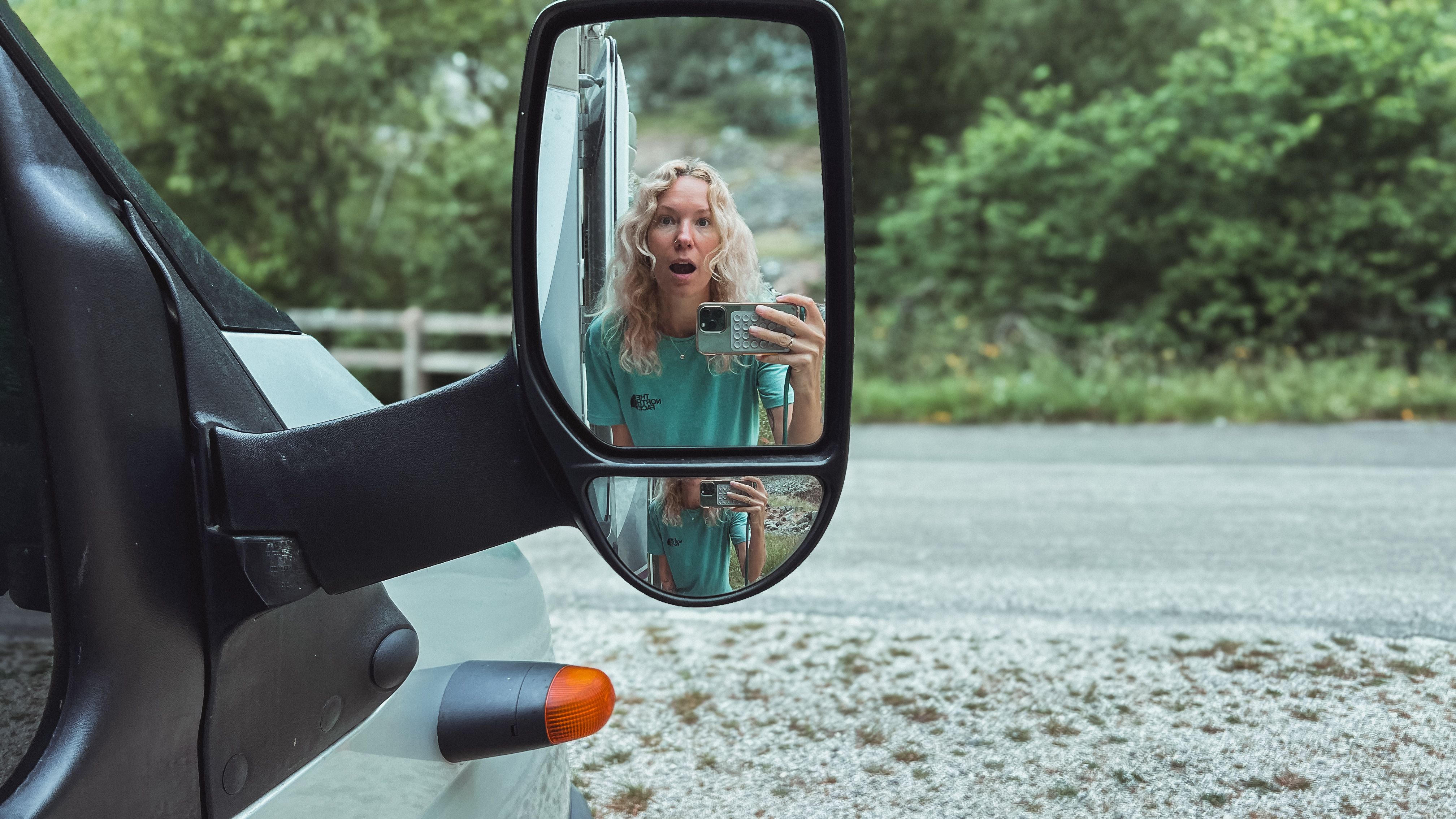
I have been living full-time in a motorhome across Europe for four years, with my husband, two large dogs, and two remote jobs between us. I have spent winters in Sicily and summers in the Italian Alps. I have wild camped in Romania, navigated strict camping laws in Slovenia, and watched my husband drive 7.25 metres of motorhome down roads that were clearly not designed for 7.25 metres of motorhome.

Most van life content will show you the sunsets. This post is about everything else.
TL;DR
- Full-time van life in Europe costs between €820 and €1,500 per month for two adults, depending almost entirely on how much you drive and whether you wild camp
- The first year is the hardest – you are constantly in the unknown, and almost everything takes longer than expected
- Wild camping is legal or tolerated in most of Western Europe, but the rules vary significantly by country and are getting stricter every year
- Travelling with large dogs is entirely doable in Europe, but requires preparation, especially for ferry crossings and countries with guard dog cultures
- Waste management, laundry, water, and waste disposal require a weekly logistics system – none of it is complicated, but all of it requires planning
The first year is harder than anyone tells you
Van life in year one and van life in year four are almost different experiences. In year one, everything is unknown. You do not yet have favourite spots, seasonal patterns, or a feel for which countries work for your style of travel. You worry about parking every single night. You second-guess every decision.
After four years, we have a rhythm. We know which regions of Spain to head to in November, which Alpine spots stay accessible into October, which ferry routes check dog vaccinations properly and which wave you through. We stay parked in one spot for up to ten days at a time when we find somewhere good.
If you are in your first year and finding it relentless, that is normal. It does get easier.
What van life costs per month in 2026
Two adults and two large dogs: between €820 and €1,500 per month. That range is wide because the two ends describe almost different lifestyles, and understanding what drives each number is more useful than quoting an average.
A minimum of around €820 per month covers the three things you cannot avoid: fuel, food, and van maintenance. Fuel is the biggest variable within that. A slow month parked in one spot in Spain or Italy, barely moving, costs far less than a month of crossing countries and driving daily. We wild camp almost exclusively, which keeps accommodation costs near zero for most of the year. We cook everything ourselves. In a recent year, we spent around £56 a month on eating out between the two of us. Most people find that figure surprising.

The higher end, €1,200 to €1,500, is where discretionary spending, medical costs, and heavy driving months stack up. We have no healthcare system. Every doctor’s visit, prescription, or dental appointment comes out of pocket, and in some months, that can add up. Add a run of countries where wild camping is forbidden, and you are paying for campsites, a month of heavy driving, some gear or clothing, and the number climbs.
The honest version of the van life cost conversation is this: the non-negotiable costs are low. What you spend beyond that is mostly a series of choices. Van life will not make you frugal by default, but it gives you the option to be, in a way that renting a flat does not.
Van life is cheaper than conventional living in Western Europe. That is not a lifestyle claim; it is a financial one.
Privacy becomes a concept you vaguely remember
Moving from a three-bedroom house to a motorhome with another adult and two large dogs means privacy becomes a negotiation rather than a given. This is not a complaint. It is something worth knowing before you commit.
You will be in the same space during every work call, every bad mood, every rainy day when nobody can go outside. There were days early on when one of us needed silence, and the other had a two-hour meeting, and you just figure it out. You develop a look that means “I need five minutes”, and the other person learns to read it. We have been together nearly sixteen years, which probably helps. But if you are planning van life as a couple and have not yet tested extended small-space living, do a month of it first before selling your furniture.
Online shopping is more complicated than you think
Pick-up lockers in most countries require a local phone number to access, which means they are not an option for us. Pick-up points work, but not every retailer ships to them, and even Amazon only does it for lower-priced items. We recently needed a new sleeping bag. Decathlon would not ship to a pick-up point. Amazon would not either. The local Decathlon did not have the one we needed and could not order it in for us. So the only option was to drive this 7.25 metre motorhome into a retail park and go shopping, which is exactly as much effort as it sounds.
It is one of those things that seems like a minor inconvenience until you are actually standing in a car park trying to figure out where on earth you are going to leave the van while you go inside.
We have learned to plan around it rather than fight it. If we know we need something, we find a larger town, park up nearby for a week or so, and use that time to collect whatever we have ordered. Smaller towns in Spain, for example, sometimes only open their post office one day a week for thirty minutes. If you miss that window, you are waiting another week. And the Google opening hours are almost always wrong. You only learn this after you have already placed the order, driven to collect it, and found a closed door and a sign you cannot read. It is one of those things that sounds funny in retrospect and is genuinely annoying in the moment.
And god help you if you need to make a return. We have had to do it a couple of times. A faulty item once required several email exchanges in Spanish before they finally agreed to send a QR code for posting it back. When we had to send our DJI drone in for repair, that was not even an option – we had to find their specific partner return point, drive there, and ask if they could print a label for us. All of this while using Google Translate to communicate. It is a lot of effort for something that would take five minutes at home.
Wild camping is getting harder across Europe
When we started four years ago, we had a list of favourite spots we relied on. Several of them no longer exist as free parking. Some were converted to paid areas. Some were banned entirely. Some now have height barriers or bollards.

This is not just a feeling. The legal picture across Europe has shifted significantly since 2022, and 2025 and 2026 brought some of the biggest changes yet. Spain introduced Instruction PROT 2026/04 in March 2026, which formally banned wild camping across seven regions, including Andalucía, Galicia, and Valencia, and tightened coastal restrictions across the whole country. Greece passed a strict overnight camping ban in 2025, then partially walked it back a few months later – the current position still bans overnight stays on beaches, in forests, at archaeological sites, and in public car parks, with on-the-spot fines of €300. Portugal has also tightened significantly since we started, with a 48-hour rule now in place and heavy enforcement in the Algarve in summer.

The increase in van life post-pandemic put pressure on spots that previously received very little traffic. Some vanlifers leave a mess, ignore no-camping signs, or set up furniture and awnings in spots where overnight parking, not camping, is technically what is permitted. That behaviour costs everyone.
Our approach: we use Park4night to find spots, check country-specific laws before we cross a border, and follow leave-no-trace practices without exception. We do not put furniture outside. We do not cook outside in areas where it is not permitted. It sounds strict, but it is the reason spots stay available.
One thing worth knowing before you look at the Nordic countries on this list: the “freedom to roam” reputation that Sweden, Norway, and Finland have applies to tents, not motorhomes. Motorhomes follow road traffic rules and must park legally. The right to roam stops at the bumper.
| Country | 2026 status | Fines | Notes |
|---|---|---|---|
| Spain | Mixed. Parking allowed in many regions if no chairs, awnings, or stabilisers out. Seven regions ban it outright under 2026 rules. | €50 to €10,000+ | Andalucía, Galicia, Asturias, Valencia among those now off limits. New S-128 sign marks legal service points. |
| Portugal | 48-hour rule outside protected areas. Banned in national parks, Natura 2000, and coastal zones. | €30 to €600 | Algarve enforcement is real in summer. Inland Alentejo and northern Portugal more relaxed. |
| France | Legal grey area, generous in practice. Bivouac allowed 7pm to 9am where not prohibited. | €135 to €1,500 | Over 5,000 aires across the country, most free or under €10. |
| Italy | Officially prohibited; widely tolerated in rural areas if no furniture is set up. | €100 to €500+ | Tolerance has dropped since 2024. More than 2,800 dedicated aree di sosta. |
| Germany | Prohibited as wild camping. One-night rest stop tolerated, no chairs or awnings. | €10 to €2,500 | Over 3,500 stellplätze, often €5 to €15 a night. |
| Netherlands | Prohibited outside official spots. | Variable | Camperplaatsen are plentiful but rarely free. |
| Belgium | Illegal. | Variable | Use designated areas. |
| Luxembourg | Illegal and enforced. | Variable | No realistic wild camping option. |
| Switzerland | Effectively illegal at lower altitudes. | High, varies by canton | Motorhomes use campsites or move on. |
| Austria | Prohibited, varies by federal state. | Up to €500 | Tirol and Vorarlberg strictest. |
| Slovenia | Prohibited and enforced. | Up to €1,000 | Beautiful country, expensive to do legally. Off-season slightly more relaxed. |
| Croatia | Prohibited, strictly enforced on coast and islands. | Up to €400 | Inland and off-season tolerance exists but is shrinking. |
| Greece | Strict under Law 5170/2025, partially eased under Law 5209/2025. | €300 on the spot; up to €3,000 or three months prison for repeats | Beaches, forests, archaeological sites, and public parking all banned. |
| Romania | Generally permitted outside parks and reserves. | €60 to €600 | Still one of the freest countries. Bears, stray dogs, and shepherd dogs are real considerations. |
| Bulgaria | Officially prohibited but widely tolerated in rural areas. | Variable | National parks enforce; rural areas rarely do. |
| Hungary | Allowed up to 24 hours in one place; banned in national parks. | Variable | Workable but you have to keep moving. |
| Czech Republic | Prohibited; one-night bivouac without a tent tolerated. | Variable | Motorhomes effectively need stellplätze or campsites. |
| Poland | Prohibited; rural spots sometimes tolerated outside national parks. | Variable | Very strict in the Tatras and on the coast. |
| Sweden | Tents covered under Allemansrätten. Motorhomes follow road traffic rules. | Variable | Tent freedom is exceptional. Motorhome freedom is more limited than the reputation suggests. |
| Norway | Tents allowed under Allemannsretten, 150 metres from houses, two nights max. Motorhomes restricted to legal parking. | Variable | Lofoten and other tourist hotspots have introduced bans outside campsites. |
| Finland | Right of Public Access applies to tents. Motorhomes follow road rules. | Variable | Same vehicle restrictions as Sweden and Norway. |
- Stellplätze – designated motorhome parking areas in Germany and Austria. Usually have water, waste disposal, and electricity hookup. Often €5 to €15 a night.
- Camperplaatsen – the Dutch equivalent. Plentiful across the Netherlands but rarely free.
- Aree di sosta – Italy’s network of dedicated motorhome stopovers. There are over 2,800 of them across the country, which makes Italy much more manageable than the “prohibited” label suggests.
Waste and rubbish: how it works
This is one of the most-asked questions and one of the least-covered topics in van life content.

We recycle everything. Inside the van, we keep separate bags for plastic, glass, food and paper at all times. When we are ready to move, we drive to an RV service point. These are spread across Europe and listed on Park4night. They provide fresh water, grey water disposal, and chemical toilet emptying – and most of them also have recycling bins. We dump everything in one stop.

In most countries, this works well. The exception, in our experience, is southern Italy – particularly Sicily and parts of Sardinia. Recycling infrastructure there is significantly less developed. Bins are few and far between, often overflowing, and in some areas we drove with two weeks of accumulated rubbish before finding a proper recycling centre. It is manageable. It is just something to know before you go.
Those small bins you see at parking spots and trailheads are for tourists – a water bottle, a wrapper, that kind of thing. They are not for vanlifers’ bags of rubbish, and filling them up is exactly the behaviour that gets spots closed. You do not dump anything in nature either. The spots that stay open for van lifers are the ones where van lifers have not trashed them.
Laundry, water, and the weekly logistics loop
Our weekly loop covers four things: fresh water, grey water disposal, toilet emptying, and groceries. We do all of it in one trip where possible. RV service points handle the first three, and most of them have recycling bins too, so we dump our sorted rubbish at the same stop. We top up LPG gas every two to three weeks, which covers cooking and the fridge.
One thing worth knowing about LPG: in Italy, it is technically illegal to fill up a van tank for anything other than running the vehicle. It is strictly enforced at motorway stations, which will flatly refuse you. Further away from motorways, in smaller towns and villages, people tend to be more flexible and will fill you up without issue. We learned this the hard way the first time we drove into Italy with an almost empty tank and pulled into the first motorway station we saw.


Laundry we do roughly once a month at a launderette. Parking the motorhome nearby is rarely straightforward – usually, we park up and walk ten to fifteen minutes carrying four massive bags of laundry, which is exactly as glamorous as it sounds. One genuinely good thing, though: most launderettes across Europe have a washing machine and dryer for pets, which has been a lifesaver with two large dogs.
The one thing that catches people off guard is winter. If we have not seen proper sunlight for an extended stretch, our solar cannot keep up with two people working on laptops all day. When that happens, we find a paid hookup spot to recharge the battery. It does not happen often, but it is worth knowing that solar alone is not always enough.
I cover more on this topic here.
Cooking in a small kitchen
I am fairly convinced our motorhome came with the smallest kitchen counter ever installed in a vehicle. It is, genuinely, the most annoying thing about this van. I always wanted to do a self-build for exactly this reason – so I could design a proper kitchen. But we do not always get what we want, and four years in, I have made my peace with it.


We only have a two-burner hob, no oven, so when we want to bake something, we use Omnia stovetop. Our prep space fits approximately half of a chopping board. Batch cooking for the week is not realistic. Multi-pan dinners are not realistic. What is realistic is simple food made with whatever is fresh and local, which in southern Europe turns out to be very good indeed.
Working remotely from the van: our setup
We both work remotely, from the same space, at the same time. Our desk is extendable so we can both sit at it, but when meetings overlap, we have a system. Whoever has the more senior people on their call gets the desk. The other one goes to the bedroom, stacks four pillows, puts a laptop holder on top, blurs the background, and we are good to go.


For video calls, especially if we both have meetings at the same time, we always hook up Starlink rather than rely on hotspotting. We started with the original dish and now use the Mini, which has been great.
For general internet, we use local SIM cards for hotspotting as we move between countries. For remote areas with no signal, which is where we most want to be, Starlink covers us. The combination means we have not missed a meeting in four years, which is genuinely the thing I am most proud of.
Our battery is lithium, which means we can run laptops and phones all day as long as we have some sun. In winter, extended grey periods require a paid parking stop with a hook-up to recharge. That happens a few times a season at most.
Travelling with large dogs in Europe

Two large dogs in a motorhome is entirely workable. Shadow and Summer travel with us everywhere. Some notes:
Ferry crossings require up-to-date vaccinations, and your dog’s EU Pet Passport will be checked. Keep it up to date before every sailing.
Italy is the most dog-friendly country we have visited. Dogs are welcome almost everywhere, which, after some of the more complicated countries, feels like a genuine relief.
Spain and France have working shepherd dogs, Spanish mastiffs and Patous, that are trained to protect flocks and will not hesitate if they feel threatened. If you hike in mountain areas, learn how to behave around them before you go, not when you are already face-to-face with one.
Romania deserves its own paragraph. There is a large stray dog population, mostly harmless, but the working shepherd dogs there are a different matter entirely. On one occasion, we were warned by mountain rescue to turn around on a trail because of dogs ahead. He was not being cautious; he was being clear that it would not end well. We turned around.

We buy dog food in bulk, four to six large bags at a time. One of our dogs has allergies, which took a while to navigate. If your dog has dietary needs, plan your supply chain well in advance rather than hoping the next town has what you need.
On the smell question, because everyone asks: yes, dogs in a van can smell, and there is nothing you can do about it when it has been raining for several days. Wet coats, wet beds, wet towels, wet shoes, wet coats – it all builds up. You put the heating on and wait for the sun. When it comes, everything goes outside. Sun does more than any product. As a daily habit, we take their beds and blankets out every morning to air, either on the roof or just shaken out and put back. In campsites, we give them proper washes.
Two health things that are non-negotiable if you travel through southern Europe with dogs. Ticks are a real problem, and we learned that a collar alone or pills alone is not enough – you need both. There were days we removed thirty ticks from Summer in one go before we figured out the right combination. The second is processionary caterpillars. They fall from pine trees between December and April and are extremely dangerous for dogs – contact with them can cause severe reactions and, in serious cases, can be fatal. During those months, we avoid anywhere with pine trees entirely.

What to expect in the first year vs year four
| Year one | Year four | |
|---|---|---|
| Parking | Stressful most nights | Routine; rely on tested spots |
| Costs | Hard to predict | Consistent and manageable |
| Driving | Frequent; always moving | Stay 7 to 10 days in one spot, typically |
| Social | Lonely periods possible | Network of van life contacts built up |
| Logistics | Chaotic | System in place; one loop covers everything |
| The hard days | Feel like failures | Feel like part of it |
The first year is the price of admission. It is worth paying 😊

FAQ
How much does full-time van life in Europe cost?
Between €820 and €1,500 per month for two adults and 2 large dogs, depending on driving frequency, country, and whether you wild camp. Fuel is the biggest variable.
Is wild camping still possible in Europe?
Yes, in most of Western Europe, but it is getting harder. Spain and Romania are the most accessible. Slovenia, Austria, and Switzerland have strict rules that are enforced.
How do you deal with rubbish living in a van full time?
We sort into separate bags inside the van and dispose of them at RV service points, which almost always have recycling bins. In southern Italy and parts of Sardinia, you may need to carry rubbish for longer before finding a suitable facility.
How do you get reliable internet in a van for remote work?
Local SIM cards for hotspotting in most countries, plus Starlink for remote areas.
Can you do van life in Europe with large dogs?
Yes. An EU Pet Passport is required for ferry crossings. Italy is exceptional for dogs. Spain and France have working guard dogs in mountain areas that require specific handling knowledge. Avoid pine trees with your dog between December and April – processionary caterpillars are extremely dangerous.
What is van life actually like in the first year?
The hardest part is not knowing your rhythm yet. You have no favourite spots, no seasonal patterns, and no system. Everything feels uncertain. It settles by year two.
Where do you do laundry when you live in a van?
Launderettes roughly once a month. Parking nearby usually means a ten to fifteen-minute walk with four bags of laundry. Most have pet washing machines too, which is a bonus.
Do you ever get kicked out of spots?
In four years, three times: once for planned road works, once when a free area was permanently closed, and once due to a wild boar virus in the area.
Which countries in Europe are bad for van life?
Countries with strictly enforced bans – Slovenia, Austria, Switzerland, and increasingly Greece – are the most limiting for wild campers. They are beautiful; you just pay for campsites or skip them.
Is van life lonely?
It depends entirely on who you are. Parking in climbing and hiking areas naturally creates social opportunities with people who share your interests. Having a partner helps. Being an introvert helps, too.
Do you miss living in a house?
Mostly the appliances rather than the house itself – a proper oven, a good blender, a washing machine, a coffee machine, and long showers. In that order.

Leave a Reply