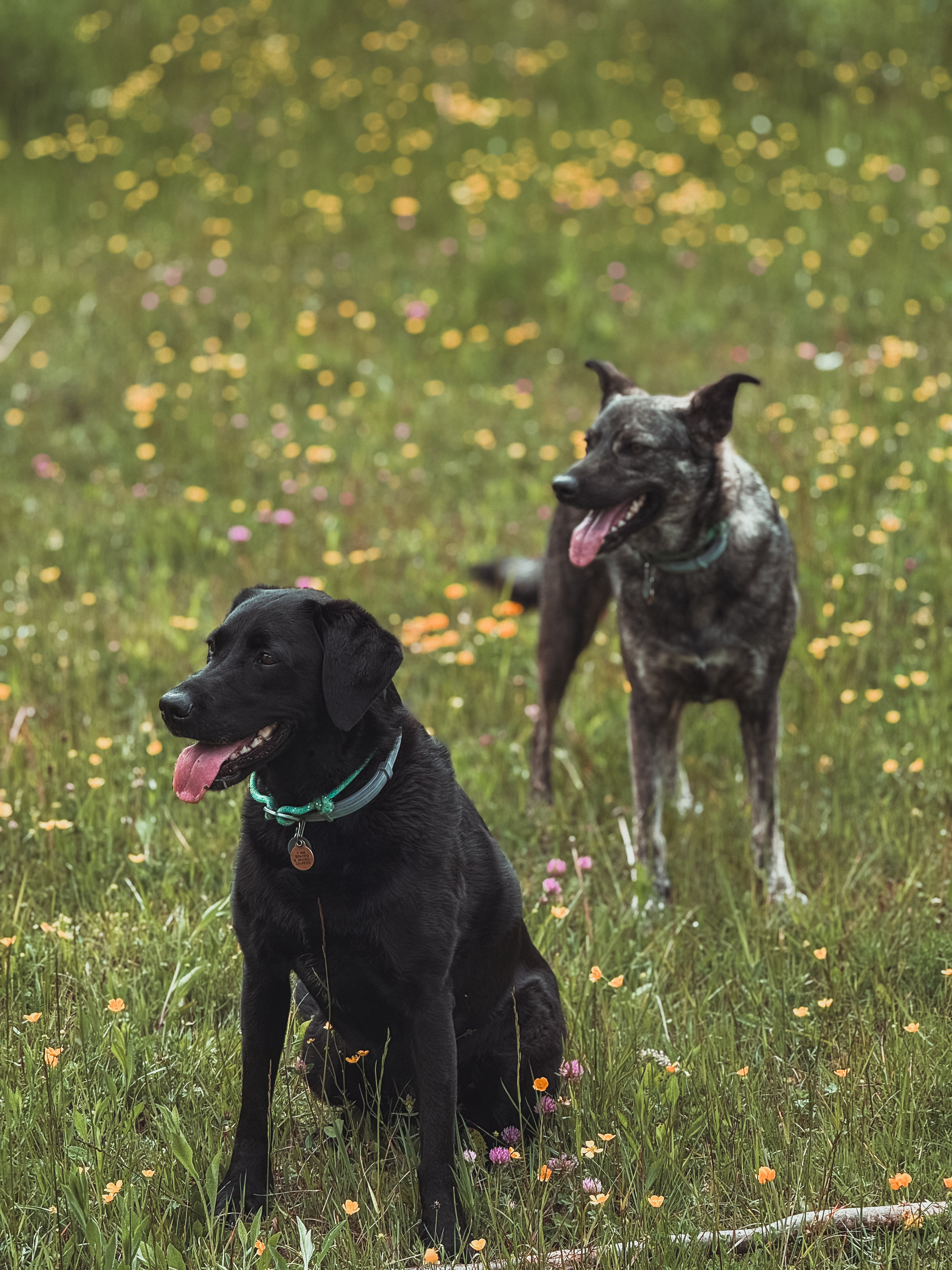
Van life with two large dogs in Europe is entirely doable, but it changes how you plan every single day, which countries you gravitate towards, and what you’re willing to give up in summer.
I’ve been travelling full-time across Europe since 2022 with my husband Tomas, our Labrador Summer, and a Romanian rescue Shadow. Both are large dogs. Both were used to sleeping on dedicated beds across three floors of a house before we compressed their world into a motorhome. Summer is seven now. Shadow just turned five. Between the two of them, we’ve travelled across 13+ countries, had one bee-sting emergency that had us driving a motorhome through central Madrid in the middle of the night for the first time ever, and a 22-hour overnight ferry to Sicily that I vlogged because I was nervous and figured if it went fine, someone else might find it useful.
It went fine.
tl;dr
- Two large dogs in a motorhome across Europe is entirely doable – we’ve been doing it for four years
- The biggest daily constraint isn’t space; it’s summer heat in southern Europe, which requires routing decisions, not just gear
- Italy is the most dog-friendly country we’ve been to; Spain and France have complications in mountain areas that are worth knowing before you go
- European ferries work well with large dogs in a pet cabin – they do not go into kennels
- Tick prevention requires both a collar and a monthly pill; one alone is not enough
Meet Summer and Shadow

Summer is a black Labrador, and she is the reason people think van life with dogs must be easy. She’s always happy, always up for a hike, always in the water if there’s water nearby. When we lived in a house, everyone who met her loved her. She was that dog. As she’s got older, she has become considerably less interested in other dogs – she tolerates them, mostly, but she’d pick a human over a dog every time. The one exception is Shadow, whom she has accepted completely and inexplicably, and who she plays with in a way she plays with nobody else.
Shadow is a rescue from Romania. We got him when he was six months old. He was, to put it diplomatically, a project. Separation anxiety, fear of strangers, zero recall, reactive to everything. We worked hard on all of it, and he has genuinely improved. But I want to be honest about where he still is in 2026, because if you’re travelling with a reactive dog and you read posts that make it sound simple, you will feel like you’re doing something wrong. You’re probably not. Some dogs are just complicated.

Shadow doesn’t react to female dogs at all – I think Summer is the reason for this, though I can’t be sure. But if a dog is a similar size or larger male, it’s 50/50. Sometimes he’s fine, and they end up playing. Sometimes he goes from zero to full-bark-and-lunge in about half a second. He has never hurt another dog – it’s more of a “make yourself seem terrifying so the other dog walks away” strategy – but it’s still something we manage every single day.
With people, he is still afraid, particularly of men. Nobody can make direct eye contact with him or try to stroke him without him barking. We’ve learned to tell people immediately: please ignore him, please don’t let your dog approach us, and we’ll all be fine. At climbing crags, both dogs are trained to lie down while we climb and play during rest periods. Shadow at a crag where people know to leave him alone is a completely different dog from Shadow in a busy car park where a stranger walks too close. Context matters enormously with him.
The thing that has changed most since we started is how we manage arrivals. If we’re parking somewhere with other vans or people nearby, he goes on a lead before the van door opens. Occasionally, as he’s jumping out, he’ll spot a movement or a person and go straight into a barking frenzy. On a lead, he settles within seconds. Off a lead in an unknown situation, we lose control of the narrative fast. That one small habit has made parking next to other people manageable.
The space question
When people hear “two large dogs, one van,” the first question is always about space. Honestly, space isn’t the hard part. The hard part is heat, smell, and rainy days – but we’ll get to those.

We chose a motorhome with an island bed specifically so the dogs could have their own spots without rearranging anything every night. They each have a side. It took a couple of years to land on the right bed solution – we went through several before I bought firm foam, cut it to shape, sewed a blanket around it, and put a yoga mat underneath. The yoga mat does two things: it stops the bed from sliding when we’re moving, and it prevents moisture from building up on the floor underneath. You can see our full setup here.
The rest of the space they treat as shared. Summer picks a spot near Tomas’s feet when we’re working. Shadow drapes himself somewhere inconvenient near the door. Despite what you might imagine, they are complete velcro dogs – they are only outside if we are outside, and even then, ten minutes in, they’re standing by the door asking to be let back in.
When the weather is bad – properly bad, like three-day grey rain in northern Spain in November – the van feels tight. There isn’t room for two large dogs to properly move around, and a wet dog smell builds in a way that is hard to describe until you’ve lived it. Wet coats, wet beds, wet leads, wet boots, all in a space smaller than most people’s kitchens. You put the heating on, you wait for the sun, and when it finally comes, everything goes outside immediately. Sun does more than any product ever has.
Summer heat, and why we stopped fighting it
Year one taught us this the hard way. We spent part of that summer at lower altitude somewhere in southern Europe, 35 to 36 degrees, trying everything: fans, shade, early-morning walks, window covers. None of it made a real difference. The nights were 25 degrees inside at midnight, with mosquitoes. The dogs were restless. I was miserable.
We don’t do that anymore. We just go somewhere cooler. Summers in the Alps, winters further south. Moving 1,000 metres higher drops the temperature by 10 to 15 degrees. The fridge works properly, the dogs sleep, and we sleep.

We don’t leave the dogs in the van in genuinely hot weather – not in the mountains, not in shade, not with windows cracked. Shade moves, vans heat up faster than you expect, and they cool down slower than you’d like. If we need to do something the dogs can’t join on a hot day, we plan around cool hours: early morning or evening. A few weeks ago, in April, a sudden heatwave hit 30 degrees, and we desperately wanted to do a via ferrata. We set the alarm for 6 am, walked them, climbed it, and were back at the van by 10. It limits what you can do on some days. That’s just the reality.
For normal life – grocery shopping, multipitch climbing, a few hours somewhere dogs aren’t allowed – we leave them in the van the same way we did when we lived in a house. They spend the whole time sleeping. We make sure they’ve had a good walk and a decent sniff session beforehand, and we’ve never left them longer than about five hours. The same principle applies as it did at home: it’s heat specifically that changes everything, not leaving them alone in general.
Dog-friendly countries, based on our experience
| Country | Best time to go | What we’ve found |
|---|---|---|
| Italy | Year-round | The standout country in Europe for dogs. Welcome in restaurants, shops, towns, and on most trails. Every time we cross the border something in us relaxes. |
| Scotland | June to August | Right to Roam law means dogs are welcome on almost all land. Midges in July and August, so bring a head net. Otherwise excellent. |
| France | Year-round | Generally very good. If you’re hiking in alpine areas, know how to behave around Patous (mountain guardian dogs protecting flocks) before you go, not when you’re already on the trail. |
| Spain | October to May | Cities are genuinely dog-loving: fenced dog parks with water fountains and play areas are everywhere, and the off-leash culture is relaxed. That same off-leash culture can make things harder if your dog is reactive. In mountain areas, Spanish mastiffs protect flocks. Summer heat in the south is not manageable in a van without AC. |
| Portugal | October to May | Too hot and too restricted in summer, with most beaches banning dogs June to September. Visit in shoulder season and it’s a different story. |
| Croatia | May, September | Dogs banned from most beaches June to September and the coast is overcrowded in peak season. Shoulder season only. |
| Romania | Any season, with caveats | Stray dogs in towns are mostly manageable. Working shepherd dogs on mountain trails are a serious matter: mountain rescue once warned us to turn around on a trail because of dogs ahead. Go informed. The country itself is stunning and the people are kind. |
Italy deserves to be said twice, because every time we cross the border with the dogs, something in me relaxes. Dogs are welcome in restaurants, shops, towns, and on trails. Nobody asks you to leave. After some of the more complicated countries, it feels like relief every single time.

Romania needs its own paragraph. On one hiking trail, mountain rescue warned us to turn around because of working dogs ahead. He wasn’t being cautious – he was being clear that it would not end well. We turned around. The stray dog situation in towns is a different thing entirely – mostly manageable, and we have obvious feelings about it, given we adopted Shadow from there. We learned to carry extra food and water for the strays we’d meet along the way. It felt like the least we could do.
We also met a beautiful retired mountain shepherd dog in Romania – abandoned, following hikers, sleeping under our van at night. He came on every hike with us for the days we were there. It broke our hearts to leave him. At that point, we already had three dogs: we’d found a tiny puppy in the mountains, skin and bones, and after a vet visit, decided to keep her until she recovered. Three weeks later, with the help of the same rescue we’d originally adopted Shadow from, she found a home in the UK. I cannot begin to explain how hard it was to hand her over. She was the perfect puppy. But Summer and Shadow had not approved of her from the start, and honestly, I wasn’t in the right mental place to take on training a puppy from scratch. Some decisions are the right ones even when they hurt.
Spain and France both have working guardian dogs – Spanish mastiffs and Pyrenean Patous – bred and trained to protect their flocks, and they will not hesitate if they feel threatened. If you hike in mountain areas in either country, the general rule is to turn around the moment you spot them if you can, or give them the widest possible berth if you need to pass – walk as far to the side as the terrain allows so they can clearly see you creating distance. We’ve been face-to-face with these dogs more times than I can count. Some were all bark. Some were genuinely threatening.
Ferries with dogs: what it’s like
We’ve done several overnight ferry crossings, but the longest was 22 hours from Genoa to Sicily with Summer and Shadow. I made a video about it because I was nervous beforehand, and it turned out to be completely straightforward.
You book a pet-friendly cabin. The dogs travel in the cabin with you. They do not go into kennels below deck. Our cabin was basic – a couple of beds and a small bathroom – but it was enough. The dogs had a sniff around, settled, and slept. There’s a dog area on the top deck. There’s a restaurant. There isn’t much else to do, which makes it a surprisingly good opportunity to read a good book or watch something downloaded beforehand (onboard data is expensive).
A few things worth knowing: not all ferry companies allow dogs on board, so check the policy before buying your ticket. Your confirmation will say boarding starts two hours before departure, but you can arrive earlier – we arrived five hours early for the Genoa crossing and weren’t the first motorhomes there. Genoa is a busy city, so put the actual ferry port on your maps rather than just searching “Genoa.” Make sure your handbrake is on, and your lights are off before leaving the van on the car deck. The ferry company will check your dog’s EU Pet Passport at boarding – keep it with your travel documents.
Dog documents: what you need and when
Within the EU, when crossing land borders between Schengen countries, nobody checks your dog’s passport. You can drive from Spain to France to Italy without anyone asking to see anything.
The EU Pet Passport matters in three specific situations: ferry crossings (companies check it at boarding), vet visits (proof of current vaccinations), and travel to or from non-EU countries – the UK, Switzerland, and some Balkan states. If you’re travelling from the UK to Europe, you’ll also need an Animal Health Certificate issued by an official vet within 10 days of departure, required for every re-entry into the EU from the UK. It’s expensive and time-consuming to organise – worth knowing before you plan your trip rather than after. Keep digital copies of everything on your phone, always.
The health stuff you need to know
Two things we treat as non-negotiable for southern Europe, and both we learned by getting them wrong first.
Ticks
A collar alone isn’t enough. A spot-on drop alone isn’t enough. We know this because there were days we removed thirty ticks from Summer in a single session before we worked out the right combination. Both together – collar and a spot-on drops during the peak tick season- is the only approach that has consistently worked.
Processionary caterpillars
They fall from pine trees between December and April and are extremely dangerous for both dogs and humans. In trees, they build distinctive white silky nests that look like cotton wool or a plastic bag caught in the branches – if you spot one, give the whole tree a wide berth.
On the ground, they move in long nose-to-tail processions, sometimes in circles, though lone caterpillars wander too – don’t assume a single one is safe. The risk isn’t just direct contact: their tiny hairs become airborne and can cause the same severe reaction without anyone touching one.

In dogs, this means intense swelling, tissue death, and potentially loss of the tongue. In humans, expect skin rashes, eye inflammation, and if hairs are inhaled, respiratory distress – children are especially vulnerable. If your dog makes any contact, even indirect, go to an emergency vet immediately. Don’t wait for symptoms. During those months, we avoid any area with pine trees entirely.
And then there are the emergencies that happen regardless of where you live.
Summer is allergic to bees. We didn’t know this until she was stung somewhere in rural Spain, roughly three hours from the nearest city, with no phone signal for the first thirty minutes. By the time we had a signal, she was in a bad way. We called every vet we could find. None of them spoke English. We eventually found a pet hospital in Madrid – the only one that responded – which told us to send a WhatsApp message with photos so they could use Google Translate to understand the situation. They said come. We drove a 7.25-metre motorhome through central Madrid for the first time in our lives, which is its own particular kind of stress when your dog is seriously ill in the back. Summer was admitted, put on a drip, and recovered fully. She carries antihistamines now.
All the emergencies we’ve had with the dogs have been natural and accidents – things that could have happened regardless of where we lived. But van life adds the layer of being far from help, sometimes without a signal, sometimes in a country where you don’t speak the language. You plan around it. You keep records on your phone. You find the vet first.
What van life costs with two large dogs
This is the question nobody puts actual numbers on, so here’s our rough picture for 2026:
Dog food varies quite a bit depending on the country and whether we catch a discount, but we’re roughly in the 60 to 80 euros per month range for both dogs combined. Summer is allergic to gluten, which took a long time to diagnose and longer to find the right food for. We buy in bulk – four to six large bags at a time. We can’t always find the same product across countries, but once we understood the ingredient list and price point we were looking for, switching brands when necessary has been fine. They’ve never had bad reactions.
Tick prevention has three layers, and you need all of them in southern Europe. A tick collar costs around 20 to 40 euros, depending on the brand, and lasts six to nine months. Spot-on drops go on monthly – around 10 euros per application, per dog. And worming tablets are given every three months. Together, it’s not a huge monthly cost, but it adds up across two dogs, and it’s non-negotiable.
Vet costs are unpredictable but generally lower than UK prices across most of Europe, particularly in Spain and Romania. We don’t pay for pet insurance – vets are affordable enough that we’ve found self-funding works out, though that’s a personal decision.
What nobody really tells you
Summer took a while to adjust to driving days, and she taught Shadow to hate them, too. Summer was never a fan of car travel – even as a tiny puppy, she would drool the whole way. Shadow, on the other hand, had been completely relaxed in cars and loved them. But dogs are pack animals, and he learned her stress faster than we expected. For the first couple of months, the moment the engine started, both of them were restless and unsettled. Now they jump into their beds and lie down. They’re not exactly thrilled – the disapproving look hasn’t gone anywhere – but their body language is calm. It just took time.
The socialisation has been genuinely good for both of them in ways I didn’t fully predict. Shadow, who came to us with significant anxiety and reactivity, has improved more on the road than I think he would have with a stable routine. The constant variety of environments and situations has made him more adaptable, not less. He’s still complicated. He probably always will be. But four years in, he’s a completely different dog from the one we collected from Romania.
Summer is an adventure dog through and through – endless energy, always first into the water. She’s also spectacularly clumsy, has had more emergency vet visits than I can count, and has joint problems we now manage carefully as she gets older. The pace has slowed slightly. She lets us know when it needs to slow down further.
I think about that sometimes when people ask whether van life is good for dogs. For these two, the answer is yes, and it isn’t a close call.
FAQ
Can two large dogs fit in a motorhome?
Yes, with the right layout. An island bed was the solution for us – each dog gets a side and doesn’t need to be moved at night. The rest of the space they share with us, which mostly works.
Is van life with dogs worth it, or does it limit you too much?
It changes what you do more than it limits you. You end up at lakes instead of beaches, you plan earlier starts, and you skip some cable cars. In exchange, the dogs come on almost everything else. After four years, we’d take that trade every time.
What’s the hardest part of van life with large dogs in Europe?
Summer heat management without AC. It requires routing your summer toward altitude rather than the coast. Once you accept that as a routing decision rather than a problem to solve with gear, it stops being stressful.
Do European ferries put dogs in kennels?
No, if you book a pet-friendly cabin. We’ve done a 22-hour crossing from Genoa to Sicily with both dogs in the cabin with us. Check each company’s pet policy before booking – not all allow dogs on board.
Do you need a dog passport to drive across Europe?
Not for land crossings between EU Schengen countries – nobody checks at those borders. You need your dog’s EU Pet Passport for ferry crossings (companies check at boarding), vet visits, and travel to or from non-EU countries like the UK. Travelling from the UK, you’ll also need an Animal Health Certificate issued within 10 days of departure, required every time you re-enter the EU.
Which European country is the most dog-friendly for van life?
Italy, without question. Dogs are welcome in restaurants, shops, towns, and on most trails. It’s noticeable every time we cross the border.
How hot is too hot to leave a dog in a van?
We don’t leave them in genuinely hot weather at all – not in shade, not with windows cracked. For normal errands and activities in reasonable temperatures, they sleep in the van the same way they would have at home. Heat specifically is what changes everything, not leaving them alone in general.
What do you do with the dogs when you go climbing somewhere they can’t?
On hot days, early starts: up at 6 am, dogs walked and fed, climb done and back before the heat builds. When there are two of us, one stays with the dogs. Both dogs are trained to lie down while we climb and play during rest periods – that training has made crag days genuinely easy.
How do you deal with working shepherd dogs on trails in Spain and France?
Turn around when you spot them, if the trail allows it. If you need to pass, give them the widest possible berth – walk as far to the side as the terrain allows so they can clearly see you, creating distance. Don’t approach, don’t make sudden movements, don’t let your dog run toward the flock. Learn this before you hike in mountain areas, not when you’re already on the trail.
How do you manage vets across Europe?
Find the nearest vet every time you move somewhere new, before you need one. Keep digital copies of vaccination records on your phone. Tick prevention: collar and monthly pill together, not one or the other. Processionary caterpillars are active from December to April near pine trees – avoid those areas during those months.
How do you stop a van smelling of dog?
You can’t fully, especially in a rainy week. Their beds and blankets come out every morning. When the sun appears, everything goes outside. Sun does more than any product. Proper washing at campsites when possible, rather than relying on sprays inside the van.
Can you get large-breed dog food everywhere in Europe?
Mostly, if you stick to brands available at Lidl, Carrefour, or Auchan. If your dog has allergies or specific dietary needs, know the ingredient list you’re looking for and plan your supply chain before you go.
Is van life with a reactive dog possible?
Yes, but it takes consistent management. Lead on before the door opens in new places. Brief people immediately – ignore him, don’t let your dog approach. Train for the situations you’re in most (crags, campsites, car parks). It’s manageable. It just requires more attention than travelling with a dog who is relaxed about everything.
Shadow and Summer have been on the road with us since 2022. If you have questions about large dogs in a motorhome, reactive dogs on the road, or specific countries – leave them in the comments or come find me on Instagram.


Leave a Reply