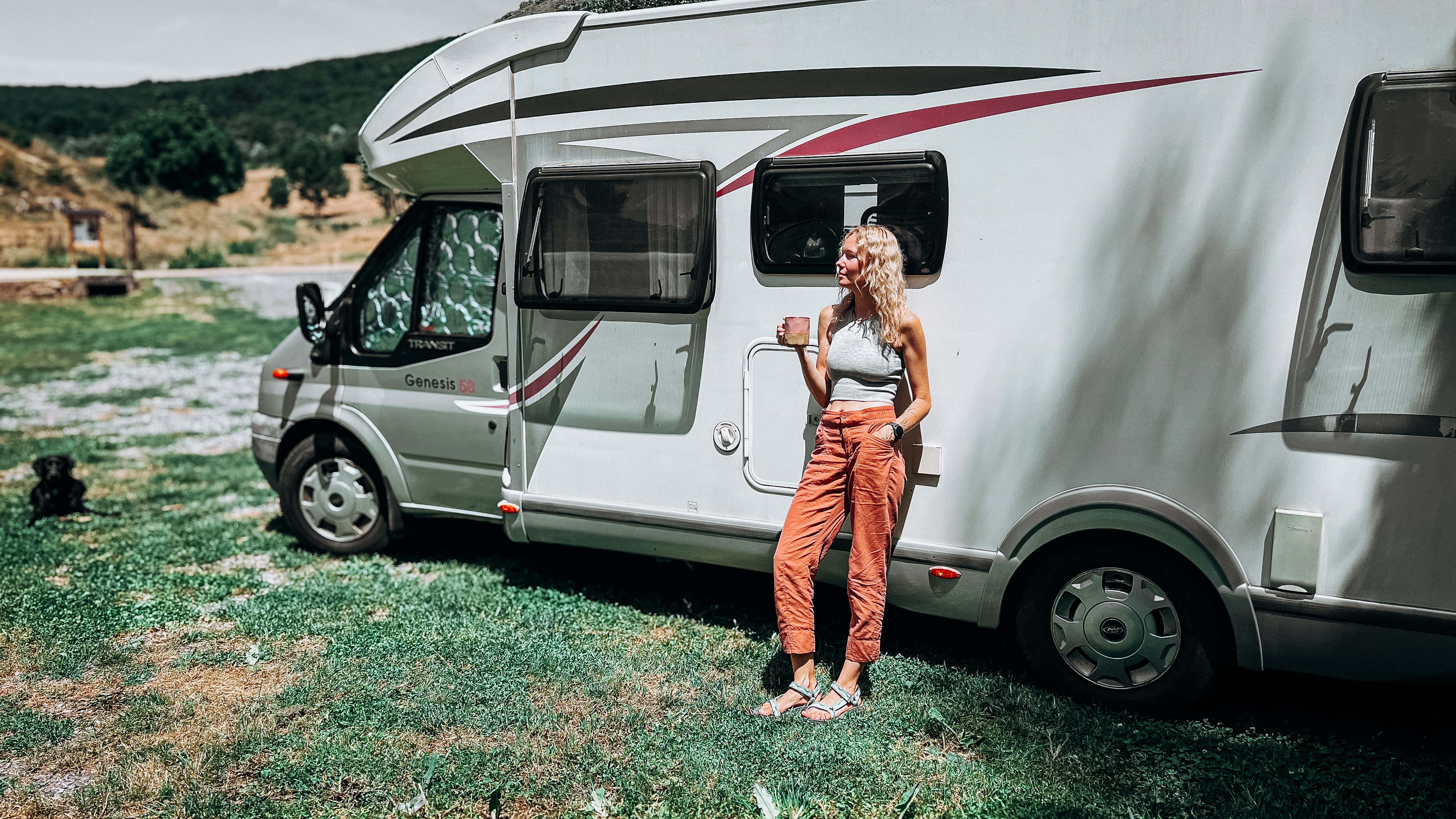
Van life in Europe is generally safe – violent crime against van dwellers is rare, and most issues are property-related (break-ins, fines for wild camping). The riskiest moments are urban overnight parking and busy summer coastal lots. Here’s what 4 years of van life across Europe has taught me about staying safe.
We’re Aelita and Tomas, and we’ve been living full-time in our motorhome across Europe for four years, covering 13 countries with our two dogs, Summer and Shadow. This is not a list assembled from other people’s advice – it’s what we have installed or researched, what we’ve learned the hard way, and what we tell anyone who asks us about vanlife security in Europe.
TL;DR
- Yes, van life in Europe is safe for most travellers – violent crime is rare; the real risks are break-ins, fines for wild camping, and bad parking choices.
- Most van break-ins are opportunistic – removing visible valuables is your single most effective first step
- A ghost immobiliser (£300–400) is the best anti-theft investment for full-time van lifers
- Use both an AirTag (~£35) and a dedicated GPS tracker for vehicle recovery, not one or the other
- Park in designated motorhome areas, not city roadsides – the outskirts of big cities are the highest risk
- iPhone 14 and later have built-in satellite SOS – set it up before you need it

Quick reference: van life security at a glance
| Security layer | What it does | Approx. cost |
|---|---|---|
| Deadlocks on doors | Physically stops entry even if glass is smashed | £200–300 |
| Ghost immobiliser | Makes the van nearly impossible to start without a PIN | £300–400 |
| Motion sensor alarm | Audible deterrent if someone enters | £20–50 |
| Dedicated GPS tracker | Real-time location if van is stolen | £80–200 + ~£8–25/month |
| Hidden AirTag | Low-cost backup tracker, no subscription needed | ~£35 |
| Security camera | Visual deterrent and footage evidence | £50–150 |
| Blackout curtains | Prevents anyone seeing inside or spotting valuables | £30–100 DIY |
| Park4Night / iOverlander | Community-verified safe overnight spots across Europe | Free / low cost |
For finding overnight spots specifically, Park4Night is our starting point – I cover the full list of apps we use in our van life travel apps post.
Do people really break into vans?
Sadly, yes, but the vast majority of van break-ins are opportunistic. Someone sees a charging cable or a bag through a window and decides it’s worth trying the door. That’s the most common scenario, and it means that simply not leaving anything visible cuts your risk significantly.
The harder truth is that if someone is determined to get in, they probably can. What all of our security choices are designed to do is make our van look like too much hassle, so that whoever is considering it moves on to something easier. Four years across 13 countries, including urban parking in cities across Western and Eastern Europe, and that approach has served us well.
How to stop someone from breaking into your van
Don’t give them a reason to try. The single most effective thing you can do is remove the invitation. Don’t leave laptop chargers, camera bags, or anything that signals valuables in view through any window. And I’ll say it bluntly – sharing your exact live location on social media while you’re away from the van is an open invitation. Sharing your adventures is fine; sharing that the van is sitting empty in a specific car park is not.
Make your van look difficult. Installing deadlocks on your doors is the next step. These are completely separate from your central locking system, so even if the glass is smashed, the door still won’t open. We had deadlocks fitted on all our doors for around £200–300 all in. They are one of the most reliable physical deterrents you can add to any vanlife security setup in Europe.
Blackout curtains serve double duty – they give you privacy while you sleep and prevent anyone outside from getting a sense of what’s inside. If no one can see in, there’s far less temptation.
How do you stop someone from stealing your van?
This is where the ghost immobiliser earns its keep. It’s a piece of hidden electrical technology that makes it nearly impossible to start the engine without entering a PIN code or carrying a specific key fob. There’s no visible switch or button – the van simply won’t start. We paid £350 for ours installed, and you can shop around between £300 and £ 400. It is the closest thing to genuine peace of mind we’ve found in four years of van life security across Europe.
Steering wheel locks and tyre locks work as visual deterrents, but we decided against them because they take up precious space, and a determined thief can still work around them. The ghost immobiliser felt like a much smarter investment.
Should you get a GPS tracker or an AirTag for your van?
This question comes up constantly in the van life community, and the answer is: both, if you can.
AirTags (Apple, ~£35) are low-cost, require no monthly subscription, and are genuinely useful as a hidden backup tracker. The downside is that they rely on other Apple devices being nearby to update location, so in remote areas, they can be slow or useless. There’s also a known limitation: since 2024, both iPhones and Android phones alert the user if an unknown AirTag has been travelling with them, which means a tech-aware thief may find and remove it before you contact the police.
A dedicated GPS tracker uses 4G cellular networks and satellite positioning to give you real-time location regardless of who else is nearby. Most require a monthly subscription of around £8–25, but they update within minutes of a theft, and that first hour is when vehicle recovery is most likely. If your van is your full-time home and everything you own is in it, that subscription is worth it.
A hidden AirTag costs almost nothing as a backup layer. A dedicated GPS tracker gives you the real-time data that actually helps police act quickly.
What should you do if someone breaks in?
Make noise immediately. Yell, bang on the walls, hit your horn. The overwhelming majority of opportunistic thieves want to be in and out without anyone knowing – the moment they realise someone is home, they run.
A motion sensor alarm is one of the cheapest investments you can make in your vanlife security setup, and they are very loud. We have one mounted inside the motorhome, and it has gone off accidentally enough times to assure us it would stop anyone in their tracks. If you’re not ready to spend on an alarm yet, even alarm stickers create a deterrent – they suggest there’s a system in place without confirming otherwise.
How we approach parking after four years on the road
A lot of van life security advice talks about apps and gadgets, but experience teaches you things no app can. Here’s how we actually think about it after four years across Europe.

Park4Night is our starting point, not our final answer. We use it for almost every overnight stop and always read the reviews carefully – recent ones especially, since a spot that was fine two years ago can have changed completely. But we treat the reviews as information, not instructions. If we pull up somewhere that has good reviews and something still feels off, we leave. That gut feeling has never been wrong.
A motorhome is not a stealth vehicle. A van can pass for a tradesperson’s vehicle parked on a street. A motorhome cannot, which means we have to be more calculated about where we park it. Because of that, we generally avoid cities altogether when we can. If we do need to go into a city, we always park in a designated motorhome area, whether that’s a paid campsite or a free aire. We never leave the motorhome on a random street or city car park.
The split system for urban errands. There have been plenty of times when we’ve needed groceries and the surrounding area has felt like somewhere we’d rather not leave the motorhome unattended. One of us goes shopping while the other stays in the motorhome with Summer and Shadow. Two dogs in a parked motorhome is its own kind of deterrent.
We park in smaller towns, not cities. If we want to explore a city, our standard approach is to park in a smaller town nearby and take public transport in. It keeps the motorhome in a lower-risk environment while we explore freely.

We never park on roadsides near big cities. Within the van life community across Europe, we’ve heard of vans stolen from laybys and roadsides on the outskirts of major cities – that in-between zone, not quite city and not quite remote, is where a lot of theft happens. If there isn’t a proper motorhome area, we keep driving until there is.
One practical note: park so you can drive straight out without reversing. If you ever need to leave quickly, you want to be able to just go.
If you are planning a summer trip, my guide to van life in Europe without AC covers how we manage heat and dogs in one.
How do you keep documents and valuables safe?
Keep passports, bank cards, and important documents in one consistent place and carry them with you whenever you leave the van. This sounds obvious, but small items genuinely disappear fast in a van; having a fixed home for everything makes a real difference.
If you’re doing a longer stay somewhere or leaving the van unattended for a longer stretch, some van lifers bolt a small safe directly to the chassis frame – completely hidden inside the build. It takes serious effort to remove, and most opportunistic thieves are gone in under five minutes.
How to stay safe when exploring solo – hiking, climbing, and off-grid
If you go hiking or exploring on your own, share your live location through WhatsApp or Apple’s Find My with someone you trust before you head out. If you’re going somewhere with no signal, let someone know your route and an expected check-in time before you lose reception.
If you have an iPhone 14 or later, there’s a satellite feature built right in that’s worth setting up before any remote trip. Using Apple’s satellite connectivity powered by the Globalstar network, you can send an emergency SOS to rescue services, share your location via Find My, and message friends and family through the standard Messages app – all with zero mobile signal and no Wi-Fi. In good conditions with a clear view of the sky, a message is sent in around 30 seconds. It works under light foliage too, though dense tree cover or deep valleys can block it. The feature is free for two years from iPhone activation and available across most of Europe. Access it through Control Centre or Settings > Satellite and try the demo at home – you do not want to figure it out on a hillside with no signal. Full details on how it works are on the Apple support page.
For a dedicated two-way option, a Garmin inReach satellite messenger lets you send and receive full messages via satellite, not just an SOS, which is reassuring on multi-day routes or genuinely off-grid terrain.
A personal safety alarm – sometimes called a Birdie – is small enough to clip to a bag or jacket and worth carrying whenever you’re out solo.
And one thing I always do that costs nothing: a whistle. Many hiking backpacks have one built into the chest strap buckle – check yours, it might already be there. If not, attach one somewhere you can reach without thinking. Three short blasts are the international distress signal, and a whistle carries far further than your voice, especially in the wind or over water.
Our motorhome set up
Deadlocks on all doors, a ghost immobiliser installed for £350, an indoor motion sensor alarm, and an AirTag hidden somewhere in the motorhome as a backup layer. Four years, 13 countries, no break-ins. If we had to strip it back to one thing, it would be the ghost immobiliser – everything else deters, but that one actually stops the van going anywhere.
Van life security in Europe doesn’t have to be complicated. A few good layers, sensible parking habits, and the discipline of never leaving anything visible get you most of the way there.
If you’re still figuring out the basics of van life in Europe, our van life apps guide covers the parking and navigation tools we use every day. And if you’re planning mountain hiking from the van, the Dolomites van life series covers parking, trail access, and what to expect on the ground.
Did this help? Come tell me on Instagram 😊

FAQ
Is van life safe in Europe?
Van life in Europe is generally safe, but how safe depends almost entirely on your behaviour and parking choices, not the continent. After four years and 13 countries, we’ve never had an incident. Most van break-ins are opportunistic – remove visible valuables, add deadlocks and an immobiliser, use Park4Night to find verified spots, and trust your gut when something feels off.
What is the best security setup for a campervan or motorhome?
The most effective setup combines multiple layers: deadlocks on all doors (£200–300 installed), a ghost immobiliser (£300–400), a motion sensor alarm (£20–50), and a hidden GPS tracker. No single measure is foolproof. The goal is to make your vehicle look like more effort than it’s worth to an opportunistic thief.
Is an AirTag good enough to track a stolen van?
It’s a useful backup but not as reliable as your only tracker. AirTags rely on other Apple devices being nearby to update location, and since 2024, both iPhones and Android phones alert users when an unknown AirTag is travelling with them, so a tech-aware thief may find and remove it quickly. A dedicated 4G GPS tracker is far more reliable for theft recovery. Use both if you can.
Where is the safest place to park a motorhome overnight in Europe?
Designated motorhome areas, paid campsites, and community-verified spots on Park4Night are your safest options. Avoid roadsides and car parks on the outskirts of major cities – that in-between zone is where most van thefts happen. Smaller towns away from city centres carry a significantly lower risk.
Should I avoid cities altogether in a motorhome?
Generally, yes, if you can. A motorhome can’t pass for a tradesperson’s van the way a plain panel van can, which changes the risk calculation. When we need to visit a city, we park in a designated motorhome area on the outskirts and use public transport. We never leave the motorhome on a random street or city car park.
What should I do if someone tries to break in while I’m sleeping inside?
Make noise immediately. Yell, bang on the walls, hit your horn. Opportunistic thieves want to go unnoticed – the moment they know someone is inside, the vast majority run. A motion sensor alarm (£20–50) does this automatically the moment a door or window opens.
Can I use my iPhone for safety when hiking with no signal?
Yes, if you have an iPhone 14 or later. Apple’s built-in satellite connectivity (via the Globalstar network) lets you send emergency SOS messages, share your location via Find My, and message people through the standard Messages app with zero mobile signal. It works across most of Europe and is free for two years from iPhone activation. Set it up via Settings > Satellite before you need it, not when you’re already standing on a hillside with no reception.
What is a ghost immobiliser, and is it worth it for van life?
A ghost immobiliser is a hidden piece of electrical technology that prevents your engine from starting without a specific PIN code or key fob. There’s no visible switch – the van simply won’t start. We paid £350 for ours to be installed, and it’s the single security measure we’d never go without. You can shop around between £300 and £ 400 for a good installation.
Do dogs help with van life security?
Honestly, yes. Two dogs in a parked motorhome is a real deterrent – most people won’t attempt a vehicle they can hear or see has dogs inside. It’s not a substitute for proper security measures, but it’s worth knowing that travelling with dogs adds a layer of protection that doesn’t cost anything extra.

Leave a Reply