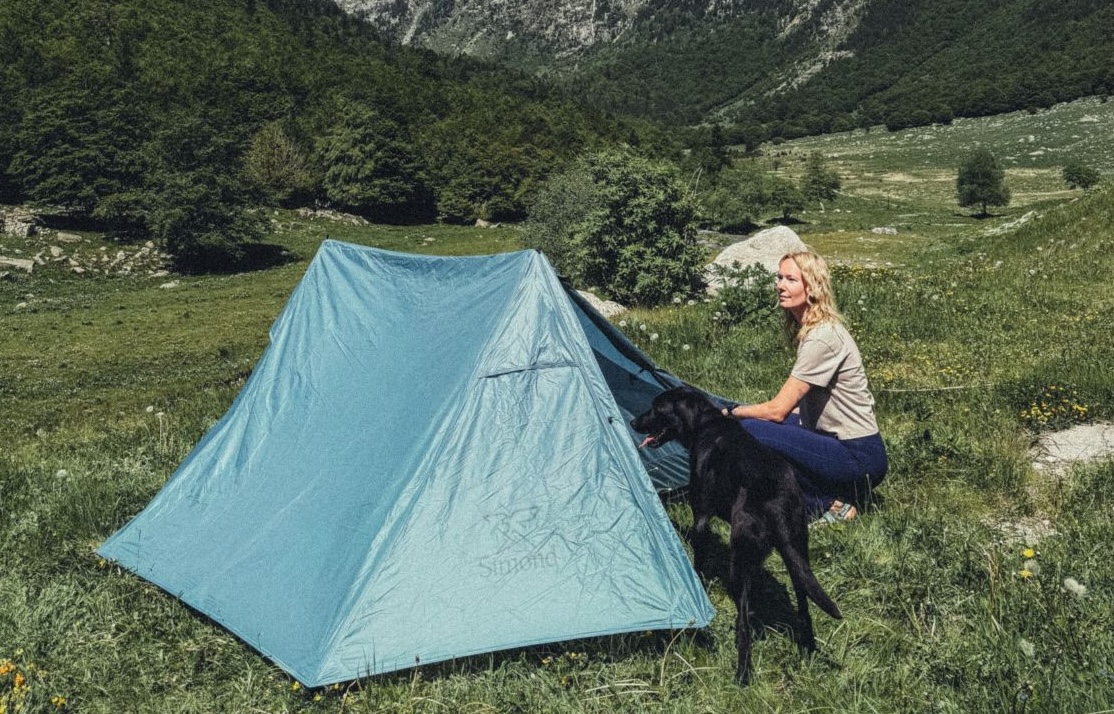
A sleeping bag for backpacking needs to match three things: the lowest temperature you’ll encounter, your sleeping style, and the fact that you’re carrying it on your back for multiple days. Get one of those wrong, and you’ll be cold, sleep-deprived, or hauling unnecessary weight up a mountain.
I spent weeks researching this before our first multi-day Pyrenees hike and came home with a bag I’d rejected twice. Here’s everything I learned, including what I’d do differently and why the sleeping mat matters as much as the bag.
tl;dr
- For summer mountain routes in Europe (Pyrenees, Alps, Cantabrians), a sleeping bag rated to 5°C comfort is a reasonable minimum; 0°C gives a better safety margin
- Temperature ratings have three numbers: comfort, lower limit, and extreme. Buy by the comfort rating, not the lower limit
- Down is lighter and packs smaller but loses warmth when wet; synthetic is heavier but keeps you warmer in damp conditions and costs less
- Foam mats cannot puncture but are genuinely uncomfortable if you’re a side sleeper; inflatable mats are warmer, lighter, and much better for sleep quality
- The sleeping system (bag + mat together) is the thing worth spending most of your budget on; it is the single biggest factor in whether you’re functional the next day
Why is the sleeping system the most important gear for backpacking?
Before van life, I camped quite a bit. Campsites, car camping… I even did a 12-day car camping trip once. I never really stressed about sleep. I brought what I had, slept fine, and that was that.

Backpacking is different: you carry everything on your back, and there’s no backup plan.
When you’re at a campsite, there’s always a bit of a safety net. Too cold? Go sit in the car. Sleeping mat awful? You probably have something else lying around. Wrong sleeping bag? You throw on extra layers and deal with it.
But when you’re a few days into a hike, up in the mountains, that safety net disappears. If your sleep setup isn’t working – if you’re freezing, uncomfortable, or your mat gives up on you – that problem follows you every single night.
And bad sleep out there isn’t just annoying; it drains you. It makes the next day harder. And the day after that.
That’s why pretty much every experienced backpacker says the same thing: if you’re going to invest in anything, make it your sleep system. Sleep is the one thing you can’t really push through for days on end.
What’s the difference between campsite camping gear and backpacking gear?
I’ve done pretty much every version of “comfortable” camping. From squeezing into a small tent with dogs, to full-on car camping setups… to, at one point, what was basically a glamping setup. Big family tent, double mattress, chairs, table – the works.

And honestly, when you have a car, why wouldn’t you? You bring the thick mat, the bulky sleeping bag, and an extra blanket just in case.
Backpacking flips that completely.
Now everything has to justify its weight. Not just your sleep setup, but your tent, food, water, cooking stuff… and in our case, dog food too.
So the question is no longer: is this comfy? It’s: is this worth carrying for days?
And that’s where some of my old gear just doesn’t translate. That super thick mat I loved? Way too bulky. The sleeping bag that felt perfectly fine at a campsite? Might not cut it higher up where nights get cold fast.
Same idea, sleeping outside. Very different standards.
How do sleeping bag temperature ratings work?
The temperature on the label has three numbers. This confused me for longer than I’d like to admit.
Comfort rating: The temperature at which a standard cold sleeper (usually defined as a woman, which is relevant if you’re female) can sleep comfortably without waking up cold. This is the number you should buy by.
Lower limit: The temperature at which a warm sleeper (usually defined as a man) can sleep without waking cold, but in a curled position, conserving heat. This is not a comfortable night – it’s the minimum before things go wrong.
Extreme: The temperature at which hypothermia risk begins. This is a survival figure, not a target. You should never plan to use a bag at its extreme rating.

For example, if a bag says 5°C comfort / 0°C lower limit / -15°C extreme, and someone shows you the 0°C number, the bag is not rated to 0°C in any useful sense. It’s rated at 5°C for comfortable sleep.
Women generally sleep colder than men. The European standard (EN 13537 / ISO 23537) tests comfort rating using a female test subject and lower limit using a male test subject, which is why those numbers differ. If you run cold, go one rating warmer than you think you need.
Down vs synthetic sleeping bag: which is better for backpacking?
This is the question I went back and forth on the most, so here’s the short version.
Down is warmer for its weight, compresses much smaller, and lasts longer if looked after. It is meaningfully more expensive. The key weakness is moisture: wet down loses its loft (the air pockets that create warmth) and takes a long time to dry. A down bag that gets damp inside a wet tent loses warmth fast.
Synthetic is heavier and bulkier at the same warmth rating, but it retains insulating ability when damp and dries faster. It’s also significantly cheaper. For someone doing their first backpacking trips and not sure how frequently they’ll use it, synthetic is the lower-risk, lower-cost choice.
For summer mountain routes in Western Europe, where rain is possible but full soaking is relatively rare, down makes perfect sense – and it’s what most experienced mountain hikers use. But at twice the price for similar warmth ratings, there’s a real case for starting with synthetic and upgrading later.
We went synthetic for the Pyrenees. The Simond Forclaz MT500 at €69.99 each: mummy shape, 5°C comfort, 1,050g in the large size. It does exactly what we need and costs half what a comparable down bag would have.
What is a backpacking quilt, and is it worth it for beginners?
A quilt is basically a sleeping bag without a hood, zip, or full enclosure. It’s lighter, packs smaller, and works well for people who run warm or move around a lot in their sleep. You can open it out fully, use it like a blanket, and adjust ventilation easily.
The downside: no hood, no collar, and more chance of heat loss around the edges if you move during the night or if the temperature drops more than expected.
I really wanted a down quilt. Everything I read pointed to it being the ideal lightweight option. Then I looked at the prices. A down quilt with around a 5°C comfort rating starts at about €170 per person, which is well above what I’d budgeted.
And to be fair, quilts do make sense. For someone like me – moving around, not loving tight, enclosed spaces, it actually sounds like a perfect fit.
But I couldn’t justify the cost as a beginner. I don’t know how often I’ll be doing this yet, and I don’t want to spend more than necessary straight away.
I also try to stick to a more minimal approach. Now that I have my synthetic sleeping bags, I’m not planning to upgrade anytime soon. My general rule is: if something new comes in, something else has to go. I have zero intention of building a collection of sleeping bags.
That said… never say never. If I end up really getting into this, I might revisit the idea.
The sleeping bag I almost didn’t buy (and why I bought it anyway)
I need to explain the black sleeping bag situation because it became slightly absurd.
We found the Simond Forclaz MT 500 on a Decathlon visit. It ticked every box: mummy shape, 5°C comfort rating, 1,050g, €69.99. A really solid option. The only issue? It only came in black.
For some reason, I had a strong and completely irrational resistance to owning a black sleeping bag. I can’t fully explain it. I just really didn’t want it.
Several weeks followed. I looked at everything in a similar price and weight range. Nothing came close in terms of warmth, weight, and price. We went back to Decathlon. We bought the black sleeping bags. I’ve made my peace with it.
If anything, this was a bit of a reality check. When something genuinely fits what you need, at a price you’re happy with, it’s probably not worth overthinking the small stuff.
Why do most backpacking beginners get the sleeping mat wrong?
The sleeping mat is the thing nobody warned me about, and it’s the thing that ruined our test run.
Before the Pyrenees, we did a one-night shakedown hike – 800m of elevation, camped overnight, hiked back the next day. We brought foam mats because they were cheap, light, and seemed fine. We are both side sleepers. We woke up with destroyed shoulders. I got about two hours of proper sleep. The next day’s hike was much harder because my body was not rested and in pain.
Comfort: Foam mats are thin – usually around 1.5 to 2cm. On flat campsite ground, this is marginal but manageable. On rocky, uneven mountain terrain, every small ridge and dip presses directly into your hip or shoulder. Side sleepers especially notice this because all your body weight is concentrated at a few points rather than distributed across your whole back.
Insulation: The mat’s job is not just cushioning. It insulates you from the ground, which draws heat out of your body far faster than cold air does. Mats are rated with an R-value that measures thermal resistance. A standard foam mat has an R-value of around 1.5 to 2. An inflatable mat like the Sea to Summit UltraLight starts at around R 3.1. For summer mountain camping, an R-value of at least 2 to 3 is the practical minimum; lower and the cold comes up through the mat regardless of how warm your sleeping bag is.
We came home from the test run and immediately ordered inflatable mats. The Sea to Summit UltraLight. They are on the pack list for the Pyrenees now.
Foam mat or inflatable sleeping mat: which do you need for backpacking?

Both, if you can manage the weight.
An inflatable mat is your primary sleeping surface. Warmer, much more comfortable, compresses to a small cylinder. The weakness is puncture risk: a slow leak in the mountains with no backup is a significant problem. Check your mat every trip and carry a small repair kit. They’re usually included.
A foam mat cannot puncture. It’s your backup if the inflatable fails, your insulation layer if conditions are colder than expected, and a useful seat or knee pad during rest stops. At around 370g for a full-length foam mat, the weight is manageable.
We’re carrying both for the Pyrenees because the foam mats are so universal, we have somewhere to sit down when eating lunch, or take a nap during the sunny 15 min break, and great for dogs to nap too when the terrain is super rocky.
If you’re choosing just one and weight is the priority, choose inflatable and carry the repair kit. If you’re doing your first backpacking trip on a real mountain route and want a fallback, carry both and leave the foam mat on top of your pack.
Do you need a pillow for backpacking?

I’m including this because I had genuinely not considered it before the test run, and I think a lot of people in the same position as me won’t either.
At a campsite, I would normally bring a small travel pillow or fold up a fleece. It’s never a big deal.
On the test run, I didn’t bring a pillow because I’ve slept without one plenty of times and didn’t think it would matter. My jacket was used to cover the dogs. I ended up sleeping with my metal water bottle under my head. And it worked, in the sense that I survived the night. It was not comfortable.
When you’re already on mountain ground, already on a thin mat, already cold, the absence of a pillow is the final thing that makes sleep genuinely difficult. We ordered inflatable pillows afterwards, and they’re now on the list. Ours weigh 159g each. That is not a meaningful weight penalty. Bring a pillow. But of course, if you’re hiking with no dogs, your jacket or other layers can replace the pillow as it does for me for plenty of years.
Should you do a test run before your first multi-day hiking route?
This is the most important point in this post, and it applies to the entire sleeping system.
Before any multi-day mountain route, do a one-night shakedown trip with the exact kit you plan to take. Sleep in the sleeping bag in the tent on the mat. Cook on the stove. Load the pack fully and hike with it for a few hours. Find out what’s missing or wrong before you’re two days from the nearest road. This will also help you figure out where to keep what in your backpack. On my very first day, I realised I had misplaced so many things, and so I stopped and reorganised stuff, so everything I need, like lip balm, sun screen is reachable as I hike.

The things we discovered on our test run that we wouldn’t have known otherwise:
- Foam mats are not acceptable for side sleepers on mountain ground
- The pillow matters more than expected
- How the tent pitches under load in the wind
- What the pack feels like loaded after six hours of hiking
Finding out your sleeping system doesn’t work in your garden is inconvenient. Finding out at altitude on day two is a real problem.
How much does a backpacking sleep system cost? What we spent
| Item | What we paid | What we’d change |
|---|---|---|
| Simond MT 500 sleeping bag x2 (5°C synthetic) | €69.99 each | The colour, honestly. I would have loved something bright, but other than that, the bag does the job at the right weight and cost. |
| Sleeping bag liner x2 | €9.99 each | You get what you pay for. I can feel it’s synthetic and not the nicest to the touch, but at the end of the day, it’s cheap insurance for warmth and cleanliness. If you’re on a budget like me, this will definitely do. |
| Sea to Summit UltraLight inflatable mat (Regular / Large) | €104.97 (R) / €127.02 (L) | Would have bought this first instead of the foam mats. |
| Foam mat x2 | €17.99 each | Nothing. They are genuinely multifunctional. We sit on them at lunch, use them when the ground is rocky, and the dogs nap on them too. |
| HIKENTURE inflatable pillow x2 | €24.99 each | Should have been on the list from day one. |
FAQ
A comfort rating of 5°C works for most summer nights on mountain routes in June, July, and August, with a reasonable margin. For shoulder season (May or September), a 0°C comfort rating is safer. If you run cold, or if your route goes above 2,500m consistently, go colder than you think you need. The nights drop faster and further at altitude than most people anticipate.
The comfort rating is the temperature at which you’ll actually sleep well. The lower limit is the minimum before things get genuinely difficult – it’s based on a warm sleeper in a curled position, and it’s not a comfortable night. Always buy by the comfort rating, not the lower limit.
Synthetic is the lower-risk choice for a first trip. It’s cheaper, it handles damp conditions better, and if you’re not sure how often you’ll backpack, it’s easier to justify the spend. Down is lighter and compresses much smaller, which matters when you’re carrying everything for seven days. For regular use on summer mountain routes, most experienced hikers use down. If budget is a constraint, start synthetic and upgrade when you know you’ll keep going.
Technically, yes, if the temperature rating is right. Practically, the problem is weight and pack size. A standard rectangular campsite bag might weigh 2 to 3kg and take up a third of your pack. A backpacking mummy bag in a similar temperature rating weighs around 1 to 1.1kg and compresses to a small cylinder. If you already own a bag in the right temperature rating and it fits in your pack, use it for a first trip. Buy a backpacking-specific bag before anything longer or more remote.
For back sleepers on relatively flat ground, possibly yes. For side sleepers, or for any terrain that isn’t perfectly flat, foam mats cause real discomfort over multiple nights because all your body weight concentrates at your hip and shoulder contact points. Foam mats also have lower R-values, meaning less insulation from the cold ground. An inflatable mat is significantly better for sleep quality on mountain routes.
R-value measures thermal resistance – how well the mat prevents heat from escaping into the ground. A standard foam mat has an R-value around 1.5. An inflatable like the Sea to Summit UltraLight has an R-value of 3.1. For summer mountain camping above 1,500m, an R-value of 2 to 3 is a reasonable minimum. Below that, cold comes up through the mat regardless of how warm your sleeping bag is, and the bag will feel far colder than its rating suggests.
A liner is a thin inner sheet that sits inside your sleeping bag. It adds between 2 and 5°C of warmth, depending on the material. It also keeps the bag clean between washes, which matters when you’re out for seven days without laundry access. At €10 to €15, it’s not expensive, and it extends the useful range of your bag. Worth having.
A reasonable starting budget for the full sleeping system (a bag, an inflatable mat, a liner, and a pillow) is €200 to €300, depending on whether you buy budget alternatives or mid-range options. The sleeping bags and mats are where the money goes. Don’t cut corners on the mat if you’re a side sleeper.
Yes. Sleep in the sleeping system, in the tent, on the ground, in conditions as close to what you’ll face as possible. A one-night overnighter with full kit, a few hours of hiking with the loaded pack, and a night’s sleep in the tent will tell you more than any amount of gear research. We found out on our test run that the foam mats were wrong, the pillow was wrong, and the tent pitch in wind was more involved than in a calm garden. You want to find all of that out before you’re two days from the nearest road.
Yes, significantly. Sleeping bags are rated assuming adequate insulation underneath. The ground draws heat out of your body faster than cold air does, so a thin or low R-value mat will make your bag feel far colder than its temperature rating suggests. The bag and mat function as a system. If your mat is inadequate, the bag cannot compensate.
Most brands lead with the lower limit rather than the comfort rating because it’s the more impressive number – a bag that says 0°C sounds warmer than one that says 5°C, even if they’re the same bag. The lower limit is the temperature at which a warm male sleeper can survive the night curled up, conserving heat. It is not a comfortable night. The comfort rating is the number you should buy by, and it will always be warmer (higher) than the lower limit.

Leave a Reply